
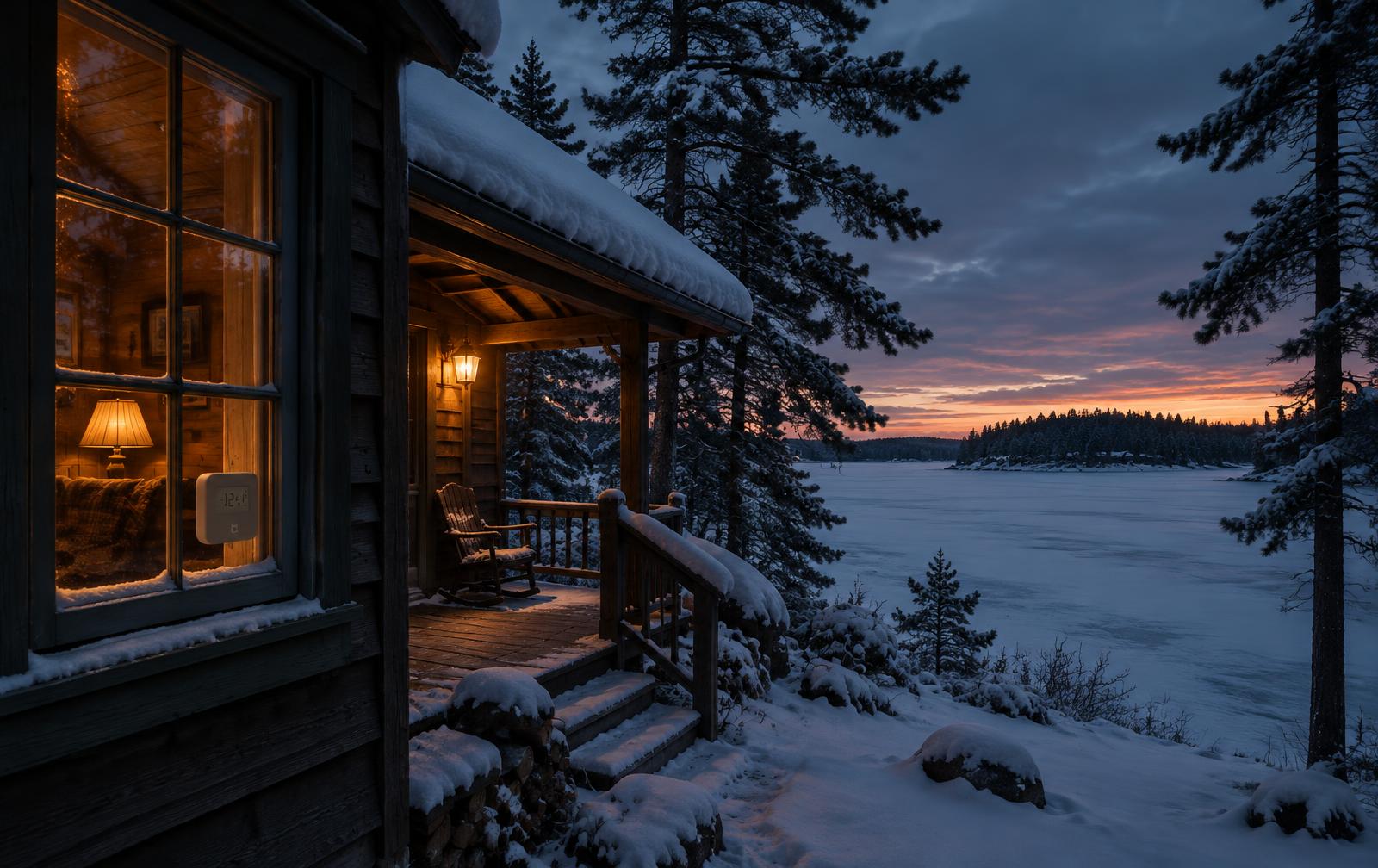
Muskoka cottage freeze
& temperature alerts.
Freeze and heat-loss alerts use wireless temperature sensors placed near your heat source and in the coldest corners of the cottage. If the furnace quits or the indoor temperature starts falling toward freezing, our team is alerted within minutes, calls you, and sends a crew before pipes burst.
- 24/7 monitoring response
- Insured · WSIB
- Replies in one business day
Why winter freeze-ups are so expensive
An empty cottage can lose heat for days before anyone notices. Once water lines freeze they split, and the damage only shows when they thaw: soaked subfloors, ruined drywall and mould behind the walls. A burnt-out igniter or an empty propane tank is a small fix. Finding it a week late is not.
Water damage is the leading cause of home insurance claims in Canada.
Insurance Bureau of Canada
Outdoor temperature at which uninsulated pipes start to face freeze risk.
IBHS
A 3 mm crack in a water pipe can release roughly 950 litres a day.
IBHS / insurer guidance
What Freeze Alerts Cover
Sensors
- Main living space temperature
- Exterior wall near plumbing
- Crawlspace or utility room
- Bunkie, boathouse or pump house
Alerts
- Low temperature threshold
- Rate-of-drop heat loss
- Hub offline or battery low
- Text, email and phone to you and our team
Response
- Call to confirm the issue
- Crew or heating trade dispatched
- Photo report when resolved
- Logged in your portal
How Freeze & Heat-Loss Alerts Works in Muskoka
- 1
Sensors placed by risk
We place sensors by the furnace or heat pump, on exterior walls near plumbing, in the crawlspace and in any outbuilding with water.
- 2
Your set point
We agree on an alert threshold, usually 7 to 10°C indoors, plus a rate-of-drop alert that catches a failing furnace early.
- 3
Alert reaches us first
Readings outside range trigger text, email and phone alerts to our on-call team. You get notified too.
- 4
We respond
We call you, confirm the issue, and dispatch a tech or trusted heating trade. You get a photo report when it is handled.
Every risk an empty cottage faces, covered.
Commercial-grade Canadian monitoring hardware, the kind trusted by airports and utilities, set up room by room for your property. Tap a sensor to see what it does.
Temperature & freeze
- Where it goes
- Main living area, crawlspace, pump house, bunkie
- What it monitors
- Air temperature to ±0.2°C, from -40°C to 60°C, all winter.
- When it alerts
- Indoor temperature drops toward 5°C or the heat stops climbing after a cycle.
- Why it matters
- A failed furnace in January can freeze and burst lines within hours. We catch the drop before the pipes do.
From a reading to a crew at your door.
- 01Sensors report in
Each sensor checks its zone on a schedule and watches its limits around the clock, so an out-of-range reading sends right away.
- 02No Wi-Fi needed
The hub connects over cellular, with Wi-Fi and satellite backup on larger properties. If one drops, it switches on its own.
- 03Keeps running in outages
Built-in battery backup (3 to 5 days) keeps it reporting through storm outages.
- 04We get the alert first
Alerts reach our team by text, email and phone. You get notified too, on your own settings.
- 05A crew rolls
We call, confirm, and send someone to fix it. You get a photo report when it's handled.
Long-range sensors reach a boathouse or bunkie up to 10 km from the hub on our larger setups.
Connectivity is built in. Nothing to set up on your router, nothing to break when you close up.
Wireless sensors run for years. We check and swap batteries on scheduled visits.
Freeze & Heat-Loss Alerts Plans in Muskoka
We don't sell single sensors. Freeze & Heat-Loss Alerts comes with the full monitoring kit and a monthly on-site check in every Wolfpack plan.
Sentry
24/7 alerts. We respond the moment something trips.
from $239/mo
Freeze & Heat-Loss Alerts included
- 24/7 freeze, leak and power monitoring
- Alert triage and owner call
- Monthly on-site check of the property and every sensor
- Island and boat-access eligible
Vanguard
Monitoring, monthly checks and your season handled.
from $619/mo
Freeze & Heat-Loss Alerts included
- Everything in Sentry
- Spring opening and fall closing
- Monthly inside and outside check with photo report
- Gutter cleaning twice a year
- Storm walk-through after major weather
Apex
Total command. Bi-weekly care and a dedicated manager.
from $1549/mo
Freeze & Heat-Loss Alerts included
- Everything in Vanguard
- Bi-weekly visits (26 a year)
- Waterfront opening and closing (dock, boathouse, pump)
- Annual window cleaning
- Spring and fall drone roof reports
- Boathouse and bunkie monitoring
Every sensor, visit and perk, side by side. Starting prices before HST.
Emergency Cottage Response in Muskoka
Your monthly plan covers monitoring and scheduled checks. Emergency callouts are billed separately, so you only pay when something actually goes wrong.
Flat dispatch fee
$250
Covers the truck, travel and the first hour on site. Most urgent problems get fixed or contained inside that hour. Extra time and parts are quoted before we go further.
Often solved in the first hour
- Shutting off the main water and draining a burst line
- Resetting a tripped furnace, breaker or pump
- Clearing a blocked furnace or dryer vent
- Securing a door, window or storm-damaged opening
- Tarping a small roof or siding breach
You set the rules
Auto-dispatch
Critical alert (freeze, active leak, no heat)? We roll a truck right away and call you on the way.
Call me first
We call your contacts in order. Nobody is sent until someone says yes.
Spending cap
Quiet hours. Pick the hours we can call or send a crew without asking, and when we should only act on critical alerts.
Contact order. List who we call first, second and third. If nobody answers, we follow the rule you picked.
Freeze & Heat-Loss Alerts Tips Before You Book
Where sensors go in a typical Muskoka cottage
Most cottages need three to five temperature points: the main living space, the coldest bedroom or bathroom on an exterior wall, the crawlspace or utility room where the pressure tank lives, and any bunkie or boathouse with plumbing. Island and water-access properties often add a long-range sensor in the pump house.
Rate-of-drop alerts catch problems sooner
A fixed threshold only alerts when it is already cold. We also watch how fast the temperature is falling. If the cottage loses three degrees in an hour on a mild night, something is wrong with the heat, and we know hours earlier.
What it does not replace
Sensors tell us something changed. They cannot clear snow off a roof or spot a broken window. That is why monitoring plans pair alerts with scheduled property checks.
Do I need Wi-Fi at the cottage?+
No. The hub reports over cellular and keeps working on battery backup during outages.
What temperature should my cottage be kept at in winter?+
Most owners set heat to 10 to 13°C. We alert below 7 to 10°C so there is time to respond before anything freezes.
Will you fix the furnace?+
We triage, reset what is safe, and dispatch a licensed heating or gas trade when needed. You approve costs first.
Can you bundle this with other services?+
Yes. Bundle 24/7 cottage monitoring with other services into one monthly plan.
More 24/7 Cottage Monitoring Services in Muskoka
Water Leak Detection
Leak sensors under sinks, by the pressure tank and water heater.
View servicePower Outage Monitoring
Alerts when the power drops, and checks when it stays off.
View serviceHumidity & Mould Monitoring
Catch damp air in closed-up rooms before mould starts.
View serviceSump & Well Pump Monitoring
Know when a pump runs nonstop or stops altogether.
View serviceWinter Property Checks
Scheduled walk-throughs with photo reports all winter.
View serviceStorm Checks
Priority visits after high wind, heavy snow or ice storms.
View service
Book Freeze & Heat-Loss Alerts in Muskoka.
Tell us about the property and what it needs. We reply with a clear plan and written prices, usually within two business days.
- 10+ yearsHands-on trades experience
- GC backgroundGeneral contractor roots
- Trusted tradesVetted partners for licensed work
- WSIB & insuredCovered on every visit
- Photo reportsProof after every visit
- Local crewBased in Huntsville